Most All-on-4® bridges carry 12 teeth per arch. Treat both the upper and lower jaw and you're looking at roughly 24 teeth in total. Designs range from about 10 to 14 teeth per arch depending on the size of your jaw, your bite, and the plan your surgeon designs for you — but 12 is the number we quote most often at Aria.
Four implants, twelve teeth — they're different numbers
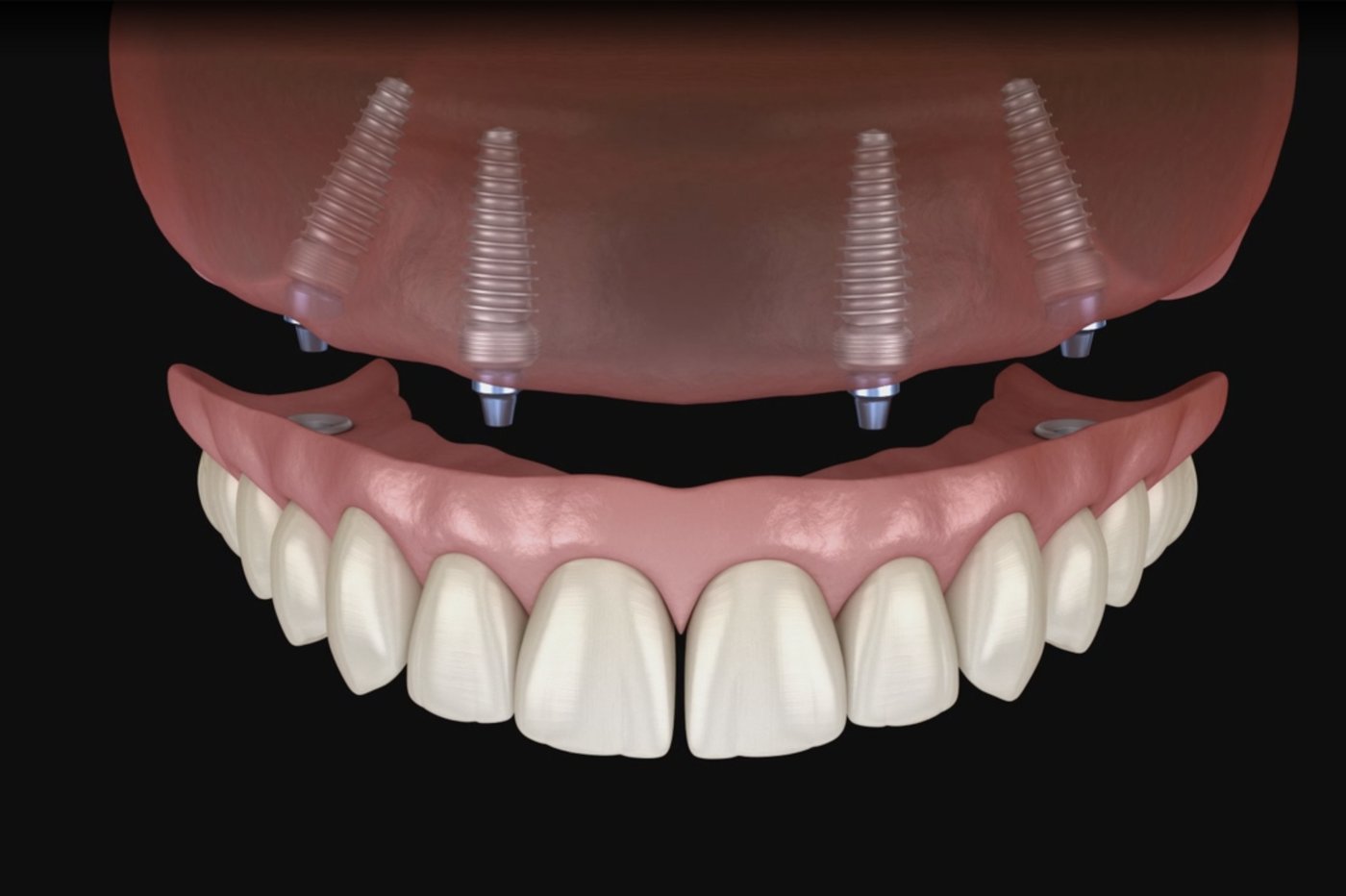
This is the single most common point of confusion, and it's worth clearing up first. The "4" in All-on-4® is the number of implants placed in your jawbone, not the number of teeth you walk out with.
Those four titanium implants act as anchors. Onto them your surgeon attaches a single, one-piece bridge carrying a full row of teeth. So four implants hold twelve teeth. Some patients need five or six implants per arch — bone volume, bite force and whether you grind your teeth all factor into that decision — but the number of teeth on the bridge stays about the same either way.
How many teeth are you supposed to have?
A complete adult set is 32 teeth — 16 in each arch — and that count includes the four wisdom teeth. Most adults have had their wisdom teeth removed at some point, which leaves 28 teeth, or 14 per arch. That's the realistic baseline most people are working from.
Your mouth has two arches: the upper (your dentist will call it the maxilla) and the lower (the mandible). Some patients restore one arch only. Others restore both, which is what people usually mean by full-mouth dental implants.
Wondering if you're a candidate?
A complimentary 3D CT scan and consultation shows your own bone on screen and gives you a straight answer — no obligation.
Schedule your complimentary consultationSo why 12 and not 16?
Because the last teeth in the jaw — the second molars — sit far back, past where the jawbone offers reliable support, and they do surprisingly little work.
A full-arch bridge typically extends back to the first molar on each side. Everything you actually use to bite, tear and grind is included. What's left out is the tooth at the very back of each quadrant, and the trade-offs for including it are real:
- Bone quality drops off toward the back of the jaw. In the upper jaw the sinus sits directly above; in the lower jaw a major nerve runs through the region. Implants are placed where the bone can genuinely support them.
- Extending too far behind the last implant creates leverage. That overhanging section is called a cantilever, and the longer it is, the more stress it puts on the implants when you bite down. Keeping the bridge shorter protects the whole arch.
- You don't chew much with your second molars. Research on shortened dental arches has found that most people chew comfortably and eat a normal diet with the premolars and first molars alone.
Twelve teeth per arch, in other words, isn't a compromise. It's the design that gives you the most function with the least risk to the implants holding it all up.
Natural teeth vs. an All-on-4® arch
| Per arch | Whole mouth | |
|---|---|---|
| Full adult set (with wisdom teeth) | 16 | 32 |
| Typical adult (wisdom teeth removed) | 14 | 28 |
| All-on-4® bridge | 12 (range 10–14) | ~24 |
| Implants supporting it | 4–6 | 8–12 |
Does the count change between the upper and lower jaw?
Sometimes, slightly. The upper and lower arches aren't the same size or shape, and your bite has to line up tooth-to-tooth when the two meet. If you're restoring one arch against natural teeth or an existing denture, the bridge is designed to match what's opposite it. Your surgeon and our in-house lab work that out together during smile design, before anything is fabricated.
"Patients ask how many teeth they'll get, but the question underneath it is usually 'will I be able to eat normally again?' Twelve well-designed teeth per arch, anchored properly, answers that question."
— The Team at Aria Dental Implant CenterWhat the teeth are actually made of
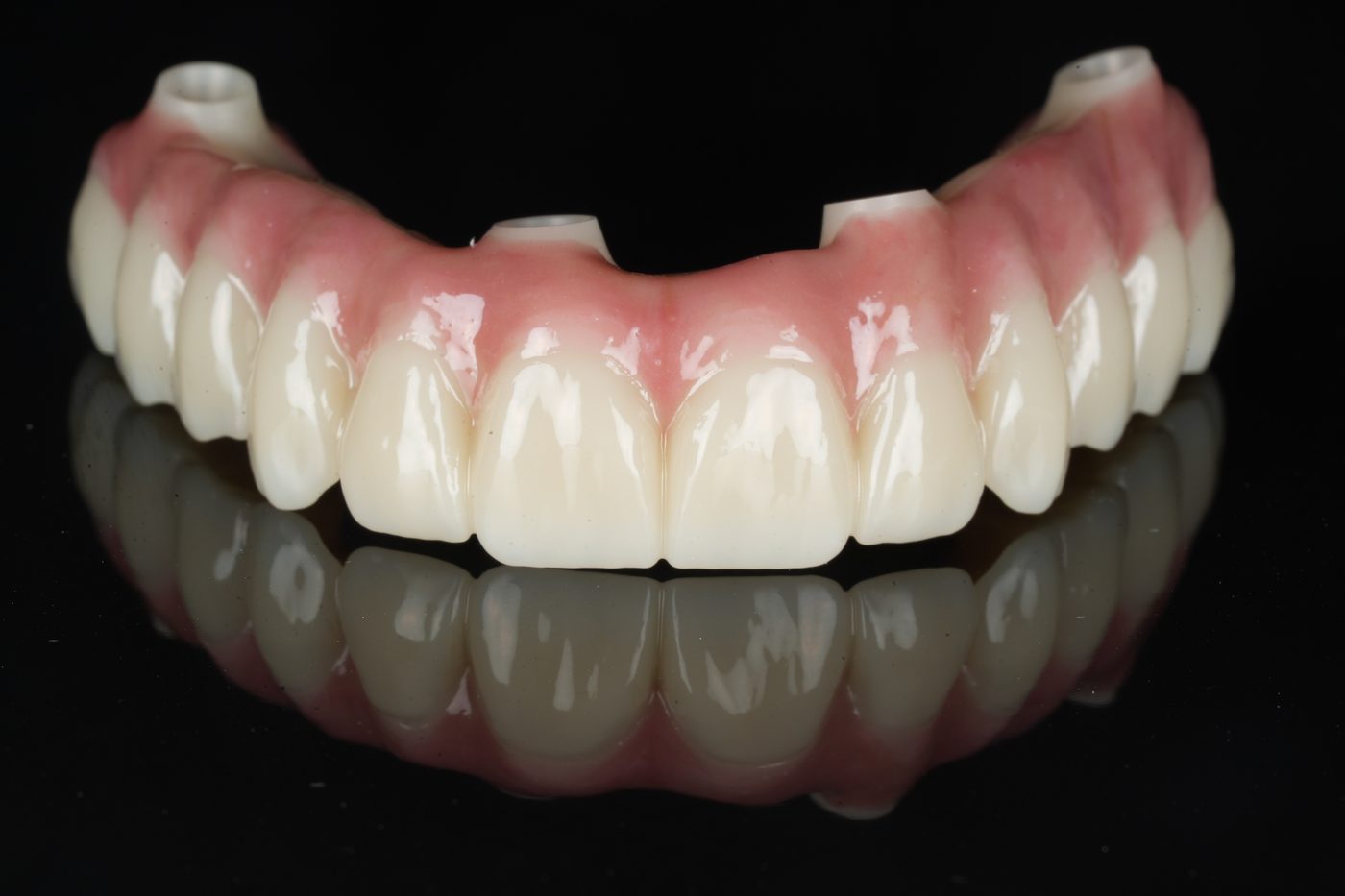
The count is only half the story — the material matters just as much. Most Aria patients receive a temporary set on the day of surgery, then a final bridge milled from solid zirconia in our in-house digital lab, often in as little as 21 days. Zirconia is strong, stain-resistant, and shaped and shaded to your face rather than to a stock mold.
Quick answers
| Question | Short answer |
|---|---|
| How many teeth on All-on-4®? | Usually 12 per arch (range 10–14) |
| Both arches? | About 24 teeth total |
| How many arches do I have? | Two — upper and lower |
| Do I only get 4 teeth? | No — 4 is the implant count, not the tooth count |
| Why not 16 per arch? | Second molars are left off — limited bone, added leverage, little chewing benefit |
Every jaw is different, and the only way to know the right number for yours is an exam with 3D imaging. At Aria Dental Implant Center in Phoenix, your complimentary consultation includes a 3D CT scan, a candidacy assessment, and a plain-English walk-through of your options — including flexible financing through CareCredit, Cherry and Proceed Financial. No pressure, and no obligation.
Related topics
how many teeth on All-on-4teeth per archfull arch dental implantshow many implants for a full archAll-on-4 Phoenixfull mouth dental implantszirconia bridgeteeth in a day