3,000+
Implant cases
Single Tooth Implants · Phoenix, AZ
A single dental implant replaces your missing tooth root-to-crown — preserving the bone beneath it, protecting the teeth beside it, and giving you something that looks, feels, and performs exactly like the real thing.
Your investment
Single-implant treatment is priced from your individual plan. Your 3D CT scan and consultation are complimentary, and you leave with your exact price, itemized, in writing, plus monthly financing options.
A consultation and 3D CT scan are required before any treatment plan or quote is provided. Individual candidacy and treatment timelines vary and are confirmed at your consultation.
Why one missing tooth matters
It's easy to assume that one missing tooth — especially a back tooth no one can see — isn't urgent. You get used to it. You adjust how you chew. You stop thinking about it most days.
But underneath the gum line, your body is already responding. The jawbone that once supported that tooth root begins to lose density the moment stimulation is gone. Neighboring teeth, no longer anchored on both sides, begin to drift over months and years. A bite that once fit together precisely gradually shifts out of alignment.
What starts as one missing tooth can quietly become a much bigger problem — more bone loss, more shifting, more wear on surrounding teeth, and a more complex (and more expensive) path to treatment the longer you wait.
A dental implant is the only tooth replacement that addresses the root cause — literally. Because the implant post replaces the tooth root, it restores the stimulation your bone needs to stay healthy, protects the teeth beside it, and gives you a result that can last a lifetime with proper care.
A single dental implant may be right for you if:
The hidden consequence of missing teeth
Most people understand that missing teeth can affect their appearance and ability to chew. What many patients don't realize is that tooth loss also leads to a serious health issue called jawbone deterioration — and the longer teeth remain missing, the greater the amount of bone that can be lost.
Natural tooth roots stimulate the jawbone every time you chew, bite, and speak. This stimulation signals the body to continually rebuild and maintain healthy bone tissue. When a tooth is removed or lost, that stimulation disappears.
As a result, the body begins to reabsorb the bone that once supported the tooth. Just like muscles weaken when they are not used, the jawbone begins to shrink when teeth are missing. Significant bone loss can occur during the first year after tooth loss — and the process continues with every passing year.
What happens when a tooth goes missing
Why traditional dentures don't stop bone loss
While traditional dentures replace missing teeth cosmetically, they do not replace the tooth roots. Because dentures simply rest on top of the gums, they do not provide the stimulation needed to preserve the jawbone.
In fact, dentures may accelerate bone loss over time by placing pressure directly on the gums and underlying bone. As bone continues to shrink, dentures often become loose, uncomfortable, and unstable — requiring frequent adjustments or replacement. This is one of the primary reasons many denture wearers eventually seek a more permanent solution.
How dental implants help preserve bone
Dental implants are currently the closest replacement to natural tooth roots available in modern dentistry. A dental implant is placed directly into the jawbone — and when you bite and chew, it transfers forces into the surrounding bone, helping stimulate and preserve healthy bone tissue.
Unlike traditional dentures, dental implants become integrated with the jawbone and provide a stable foundation for replacement teeth that can last a lifetime.
At Aria, we frequently meet patients who believe they have waited too long. Advances in digital treatment planning and bone regeneration procedures have made it possible to help many patients who were previously told they were not candidates. The best time to act is now.
Schedule your complimentary consultationUnderstanding your options
If you're missing a tooth, you have choices. Here's an honest look at what each one means for your long-term bone health and quality of life.
The Aria single implant
A dental implant is a three-component system engineered to replicate the full structure of a natural tooth — from the root in your jawbone to the crown in your smile.
A small titanium post — the implant itself — is placed in the jawbone during a minor surgical procedure. Over the healing period, the post integrates with the surrounding bone through osseointegration, creating a stable, permanent anchor for your new tooth.
Once the implant has integrated, a small connector called an abutment is attached to the post. The abutment sits just at gum level and provides the connection point between the implant and your custom crown.
A ceramic crown — custom-designed and fabricated through Aria's in-house digital laboratory to match the shape, size, and shade of your natural teeth — is secured over the abutment. The result looks and functions indistinguishably from a natural tooth.
Before placement, your anatomy is evaluated with a 3D CT scan. This lets Dr. Joe plan the exact position, angle, and depth of the implant with precision — maximizing bone contact, avoiding critical structures, and ensuring the best possible long-term result.
Your crown is designed and fabricated at Aria using digital workflows and precision ceramic technology. Because our lab works directly with your clinical team, fit, color, and feel are refined to your exact specifications — not sent out and guessed at from a mold.
From your consultation and 3D scan through implant placement and final crown delivery, you see the same team throughout your treatment. Continuity of care isn't just more comfortable — it leads to better outcomes.
What to expect
Every step is coordinated under one roof — no referrals to outside specialists, no confusion about who is doing what.
Dr. Joe Mehranfar has placed more than 3,000 full-mouth implant cases and lectures internationally on digital implant technique — bringing that same level of precision and experience to every single-implant case at Aria.
Our in-house digital laboratory means your crown is designed with precision technology, refined to match your natural teeth in form, function, and appearance. Nothing leaves the building guessed at.
If bone grafting is needed due to prior bone loss, that work can often be performed at the same appointment as implant placement — and Aria's team will walk you through exactly what is involved before you ever commit to anything.
The right time to replace a missing tooth is now, before more bone is lost.
Real patients · Real results
Individual results vary.
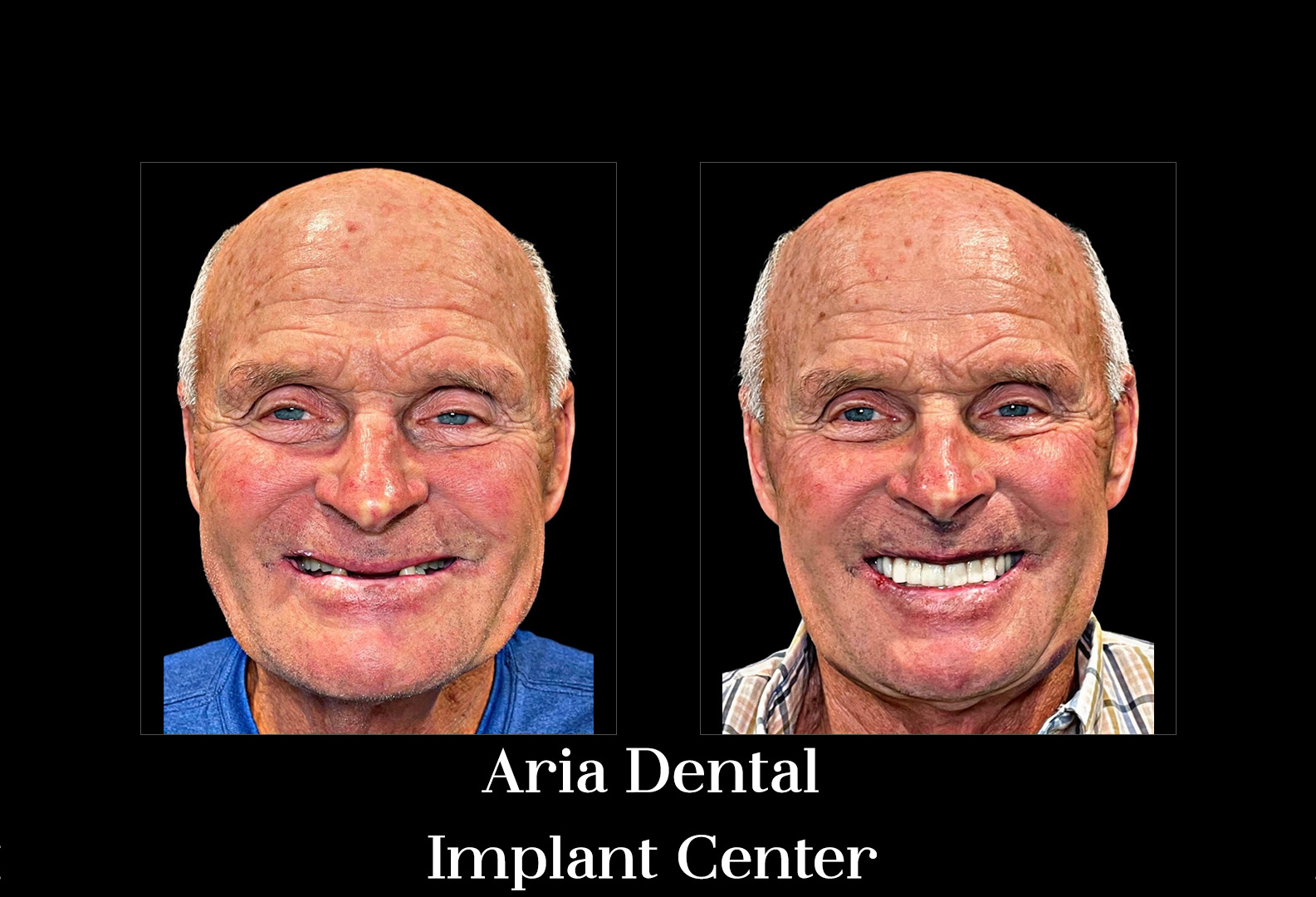
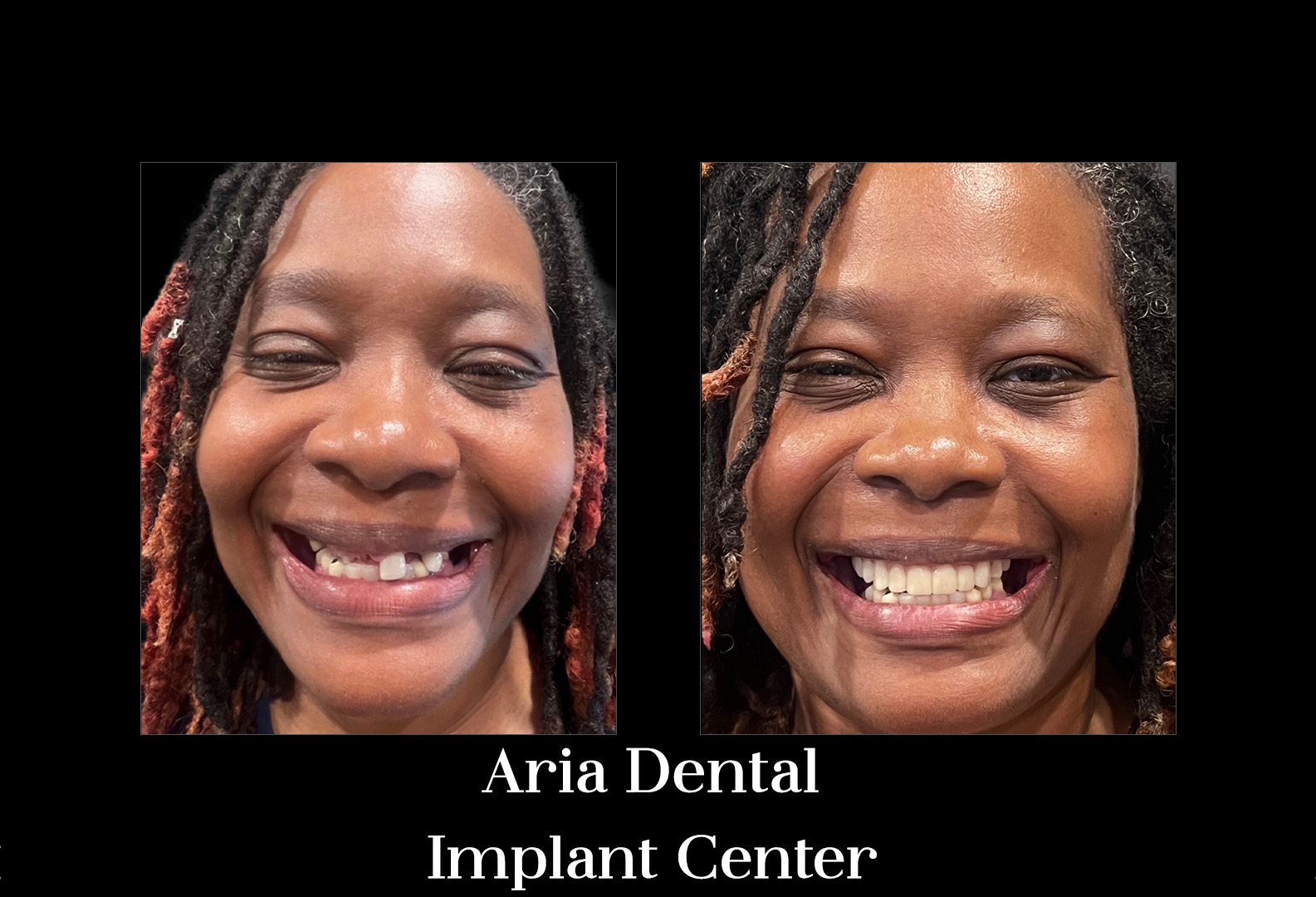
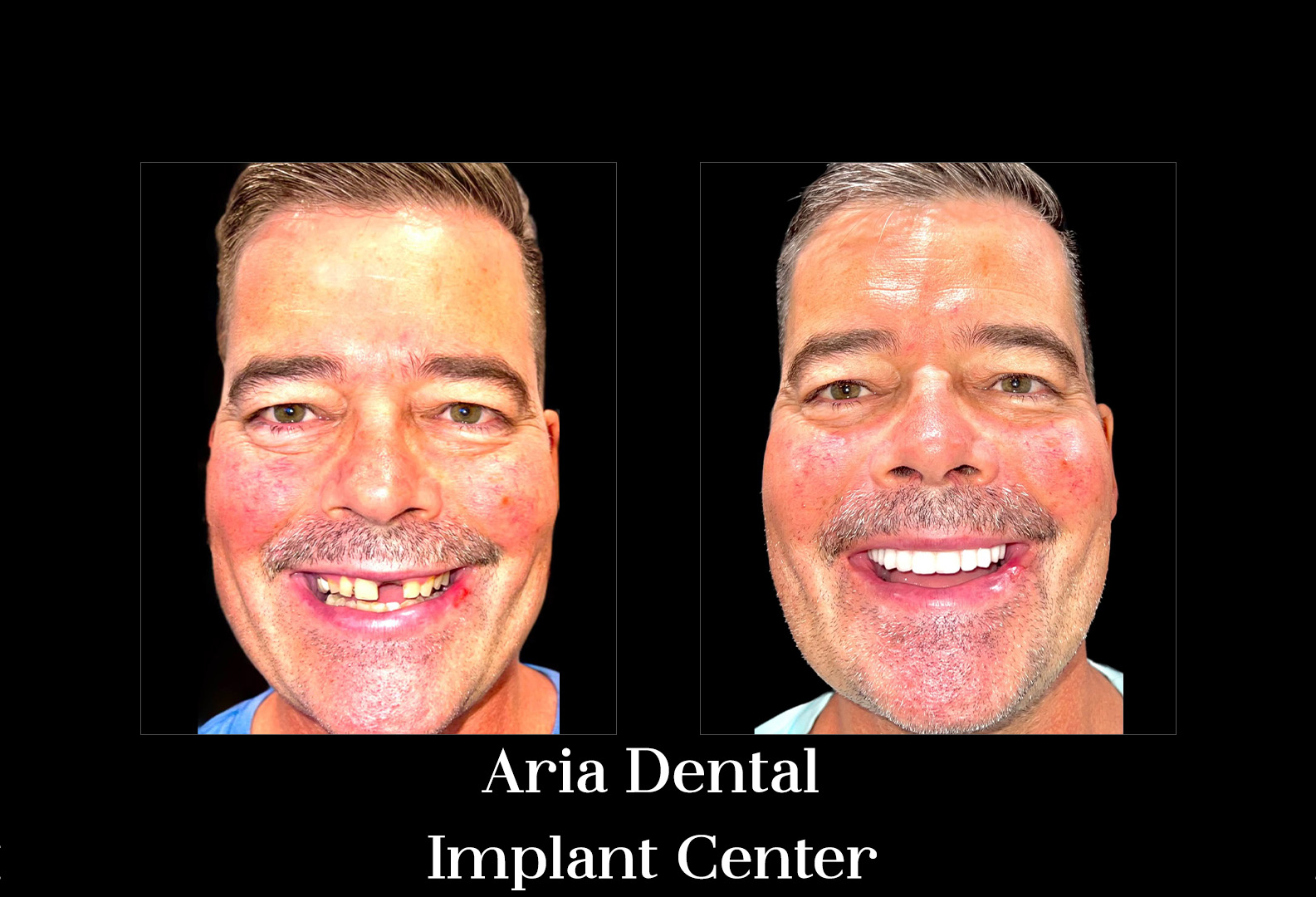


Complimentary consultation
A 3D CT scan at Aria reveals exactly how much bone you have and which options are available to you. There is no charge and no obligation — just answers.
Schedule your 3D CT scan & consultationInvestment & financing
The cost of a single dental implant depends on several factors specific to your anatomy and treatment plan: bone volume at the implant site, whether a bone graft is needed, the type of crown material selected, and the number of teeth being replaced. Aria reviews your exact, itemized pricing — in writing — at your complimentary consultation — so you have all the information you need to make a confident decision.
It's also worth noting: the cost of placing an implant now is almost always less than the cost of waiting. Bone grafting, orthodontic correction for shifted teeth, and the cumulative cost of bridges that eventually fail all add up. An implant placed at the right time is the most cost-effective long-term solution available.
Aria does not accept dental insurance — we are out of network by design — but our team will complete the form for you to submit to your insurance carrier. Coverage varies significantly by plan; the consultation is a good time to ask about what reimbursement may be available for your specific insurance.
Financing options
We partner with several third-party financing companies to offer flexible monthly payment plans that make implant treatment accessible. Many patients are surprised by how affordable the monthly cost is when spread over time.
Common questions
A single tooth dental implant is a three-part replacement for a missing tooth: a titanium post (the implant) that anchors into the jawbone and replaces the tooth root, a connector piece called an abutment, and a custom ceramic crown on top that matches your natural teeth. Together they look, feel, and function like a natural tooth — and unlike a bridge, no neighboring teeth are altered.
When a tooth is lost, the jawbone beneath it loses the stimulation it needs to stay dense and healthy. Bone resorption begins within weeks, and the greatest loss of ridge width happens during the first year after extraction. As bone diminishes, neighboring teeth begin to drift into the gap, bite alignment changes, and future implant placement may require bone grafting. The sooner a tooth is replaced with an implant, the more bone is preserved and the simpler the treatment.
A dental bridge fills the gap by crowning the two teeth on either side and suspending a false tooth between them. This requires permanently grinding down healthy adjacent teeth to place the crowns — sacrificing tooth structure that cannot be restored. It also does nothing for the bone beneath the gap, which continues to resorb. A dental implant goes into the bone itself, replaces the root, stops bone loss, and leaves the neighboring teeth completely untouched. In the long run, an implant is almost always the more conservative and durable choice.
The implant placement procedure is performed under local anesthesia, and most patients report being surprised at how comfortable it is during the procedure. Some tenderness and mild swelling in the days following surgery is normal and is typically well-managed with over-the-counter pain relief. Dr. Joe's extensive surgical experience is one reason Aria patients consistently report very positive procedure experiences.
The process involves three main phases: implant placement, a healing period for osseointegration, and a final appointment for the abutment and crown. Your specific timeline depends on your bone density, anatomy, and how quickly you heal. Your Aria team will give you a clear timeline at your consultation based on your 3D CT scan — so you know exactly what to expect before treatment begins.
In many cases, implants are still possible even after years of bone loss — though a bone graft may be needed to rebuild the volume necessary to support an implant securely. Many patients who have been told they don't have enough bone are surprised to learn they are still candidates. A 3D CT scan at Aria is the only accurate way to evaluate your current bone volume and determine the best path forward. There is no charge for the scan and consultation.
The cost of a single dental implant depends on your individual anatomy — bone volume, whether a graft is needed, and the crown specifications. Aria reviews your exact, itemized pricing — in writing — at your complimentary consultation. Flexible monthly payment plans through multiple financing partners are available. The consultation is always at no charge, so you can get all the information you need before making any decisions.
Explore all treatments
If you're evaluating options for several missing teeth or a full arch, our team has solutions for that too.
Replace a full arch of missing or failing teeth with permanent fixed teeth — often the day of surgery. Four strategically placed implants support a complete, non-removable smile.
Learn about All-on-4® →When every tooth in an arch needs to be replaced, full-mouth restoration offers a complete fixed solution — customized to your anatomy, designed for a lifetime of use.
Learn about full-mouth restoration →Aria's final restorations are crafted from custom zirconia — the strongest, most natural-looking ceramic available — precision-milled through our in-house digital laboratory.
Learn about zirconia restorations →Get started today
The scan alone is valued at hundreds of dollars. We offer it at no charge because we believe you deserve to understand your options before making any decisions.
Prefer to talk first? Call or text 602-877-0429
Just have a question? Send us a message