Yes, gum tissue grows around a dental implant. As you heal, the gum closes up against the implant and forms a snug collar — your dentist will call it the peri-implant mucosa — that seals the area off from bacteria. What it does not do is grow over the crown, or grip the implant the way gum grips a natural tooth. It hugs the surface rather than anchoring into it, and that single difference explains almost everything about how implants need to be cared for.
Timelines are typical, not guaranteed. Healing varies with your health, whether you smoke, and the specifics of your case.
How gum attaches to an implant — and why it's different
Around a natural tooth, gum fibres run into the root surface at an angle, like the guy-ropes on a tent. Underneath, a periodontal ligament cushions the tooth and carries a rich blood supply that helps the body fight off invading bacteria.
An implant has neither. It fuses directly to bone — that's osseointegration — with no ligament in between. The gum fibres around it run parallel to the implant surface rather than into it. The seal that forms is real and it works, but it's more of a close-fitting cuff than a locked attachment, with less blood flow behind it.
The practical consequence: an implant is superbly stable but slightly less able to defend itself against plaque than a natural tooth. That's not a flaw in the treatment. It's simply the reason daily cleaning and regular maintenance visits matter as much as they do.
| Natural tooth | Dental implant | |
|---|---|---|
| Gum fibre direction | Insert into the root | Run parallel to the surface |
| Periodontal ligament | Yes — cushions and supplies blood | None — fused straight to bone |
| Seal against bacteria | Strong | Effective, but more delicate |
| Response to plaque | Gingivitis | Peri-implant mucositis |
| Daily cleaning | Essential | Essential — arguably more so |
What healing actually looks like, week by week
Days 1–14: the tissue closes
The gum knits together around the implant or its healing cap. Some swelling and pink-tinged saliva in the first few days is normal. Keep the area clean but be gentle — no vigorous rinsing or poking at it.
Weeks 2–8: it firms up
Soft, slightly puffy tissue gradually becomes tighter and paler as it matures. The collar around the implant tightens into its protective seal. Any tenderness should be steadily decreasing, never increasing.
Around 3 months: the contour settles
The gum line finds its final shape. This is why we don't rush the permanent crown or bridge — the restoration is designed to meet tissue that has finished moving, so the result looks natural and stays that way.
Wondering if you're a candidate?
A complimentary 3D CT scan and consultation shows your own bone on screen and gives you a straight answer — no obligation.
Schedule your complimentary consultationWill the gum grow around a crown?
It will contour around the base of it. In a well-planned single-implant case the crown emerges through the gum so convincingly that patients can't pick it out in the mirror — it looks like it's growing out of the tissue, because visually it is.
The gum won't grow up over the biting surface. And one honest caveat: the small triangle of gum between two teeth — the papilla — fills in more predictably between an implant and a natural tooth than it does between two implants side by side. Where that matters cosmetically, we plan for it before surgery rather than hoping for it afterwards.
Do gums grow around a bridge or a full arch?
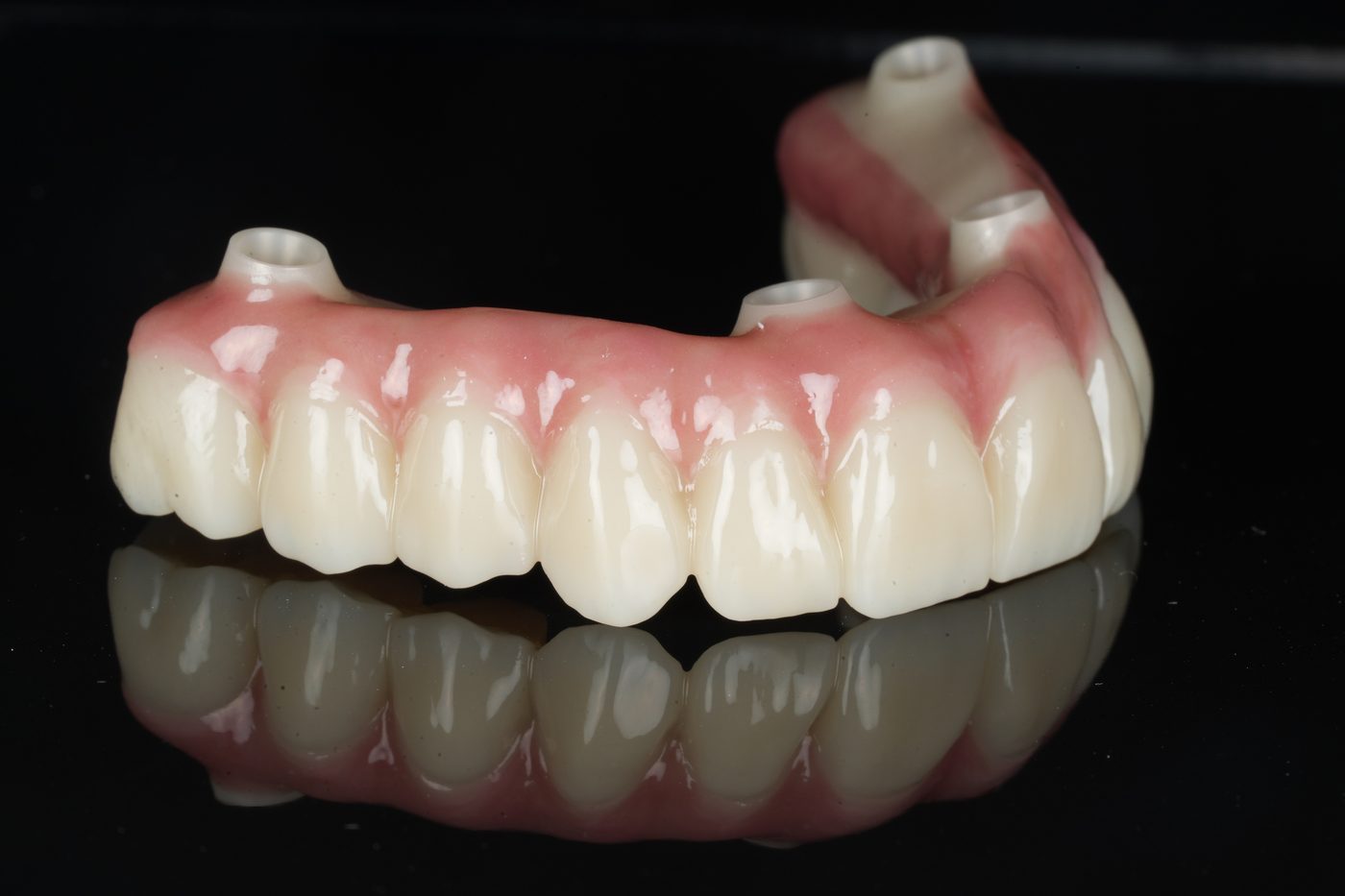
Tissue adapts up to the underside of the bridge, but it does not grow into it or through it. That underside is designed deliberately: smooth, convex, and shaped so a water flosser can sweep beneath it. On a full-arch All-on-4® case the entire fitting surface is planned for cleanability, because the tissue underneath needs the same daily attention as the teeth you can see.
If gum ever looks like it's creeping up onto or over the edge of a bridge, that's overgrowth from irritation, not healthy healing. Call us — it's straightforward to sort out.
When gum grows over a healing abutment
This one comes up often enough to name it. Between surgery and the final restoration, a small healing cap sits at gum level to shape the tissue. Sometimes the gum simply grows enthusiastically and creeps over the top of it.
It isn't an emergency and it isn't a sign the implant is failing. Your dentist can uncover it in a short, routine visit. Don't try to push the tissue back yourself — just call the office.
"Healthy gum around an implant should look calm, pale pink and tight. If it's red, puffy, or bleeds when you brush, that's the tissue asking for help — and caught early, it's almost always reversible."
— The Team at Aria Dental Implant CenterWhen gum around an implant is telling you something
Call us if you notice any of the following. None of them mean disaster, but all of them are worth looking at sooner rather than later:
- Bleeding when you brush or floss around the implant. The most common early sign of peri-implant mucositis — the implant equivalent of gingivitis. It's inflammation of the gum only, and at this stage it's usually reversible.
- Redness or swelling that doesn't settle beyond the first couple of weeks after surgery.
- A persistent bad taste or odour, or any pus.
- Tenderness that's increasing rather than fading.
- The crown starting to look longer, or a visible edge appearing — that can indicate recession.
Left unaddressed, gum inflammation can progress to peri-implantitis, where the bone supporting the implant begins to be lost. That's the stage you want to stay well ahead of, and it's precisely what routine maintenance visits are for.
Keeping the seal healthy
- Brush twice daily with a soft brush, angled gently at the gum line.
- Use a water flosser daily. For full-arch bridges this is the single most valuable habit you can build.
- Clean between with implant-safe floss or small interdental brushes where your hygienist recommends them.
- Keep your maintenance appointments. Implants need specific instruments and a specific technique — this is not an ordinary cleaning.
- If you smoke, know that it matters here. Smoking meaningfully raises the risk of peri-implant problems and slows soft-tissue healing.
We cover the full routine on our implant maintenance page.
Quick answers
| Question | Short answer |
|---|---|
| Does gum grow around implants? | Yes — it forms a protective collar of tissue |
| Does it attach like a natural tooth? | No — it hugs the surface instead of gripping into it |
| Will it grow over the crown? | No — it contours around the base |
| Do gums grow into a bridge? | No — the underside is designed to stay cleanable |
| How long does it take? | Closes in 1–2 weeks; contour matures by ~3 months |
This article is general information, not a diagnosis. If something about your own healing doesn't feel right, the fastest path to peace of mind is to have it looked at. Call Aria Dental Implant Center in Phoenix at 602-877-0429 — we see our own patients promptly, and we offer second opinions for people treated elsewhere.
Related topics
does gum grow around dental implantsgum around implant crownperi-implant mucosaimplant gum healing timeperi-implantitisgum recession around implantsimplant maintenance Phoenixhealing abutment